Summary – “Section 214 of the Housing and Community Development Act of 1980, as amended (“Section 214”), prohibits the Secretary of HUD from making financial assistance available to persons other than United States citizens or certain categories of eligible noncitizens in HUD’s public and specified assisted housing programs. This proposed rule would revise HUD’s Section 214 implementing regulations to require the verification of U.S. citizenship or the eligible immigration status of all applicants and recipients of assistance under a covered program regardless of age. The proposed rule would also make prorated assistance a temporary condition pending verification of eligible status of all family members, where permitted by statute, as opposed to under HUD’s current regulations where prorated assistance could continue indefinitely. These amendments would bring HUD’s regulations into greater alignment with the wording and purpose of Section 214 and align with the current Administration’s priorities and regulatory reform efforts.”
The comment period that ends in 60 days (April/21/2026).
Highlights from the Regulatory Impact Analysis (attached)
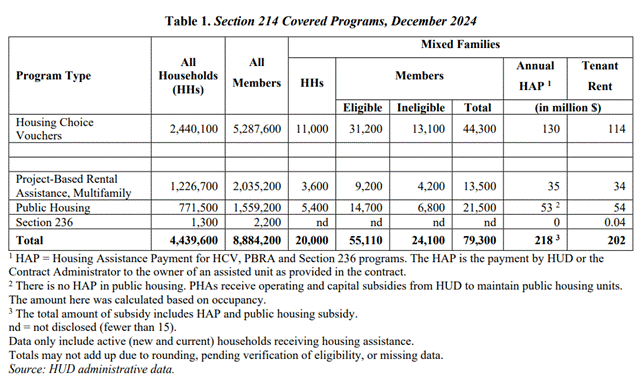
“According to HUD data, as of December 2024, there were approximately 20,000 mixed families with at least one ineligible member (Table 1) receiving housing assistance. Among these mixed families, 70 percent of family members are eligible members and 30 percent are ineligible. Among the eligible family members, 65 percent are children (0-17 years old), 32 percent are adults (18-61 years old), and 3 percent are elderly (62 and over). Among the ineligible members, 4 percent are children, 90 percent are adults, and 5 percent are elderly. Most mixed families have three eligible members and one ineligible member. The average mixed family is larger and has more eligible members (3 eligible persons) than the average non-mixed family (2 eligible persons).
Geographically, 71 percent of mixed families are concentrated in three states—California (36 percent), Texas (22 percent), and New York (13 percent). The rest of the mixed family population is scattered across the country, with 4 percent or fewer mixed families per state. The majority of PHAs and project (housing) owners have few mixed families, if any. In 2024, 92 percent of PHAs had mixed families representing less than five percent of their assisted households. Among private owners of rental housing, 97 percent of them have mixed families representing less than five percent of their assisted households.
The mixed families receive an aggregate annual subsidy of approximately $218 million and make tenant rent payments of $202 million annually. The average annual subsidy received by mixed families is about $11,000 per household ($218 million/20,000), which is equivalent to $2,800 per person ($218 million/79,300). On average, a mixed family has four household members (79,300/20,000).”
Keep Families Together– advocacy resources in opposition to this proposed rule. (This is a resource that was shared with NAHMA and industry partners, as part of broader affordable housing coalition. It is not an endorsement.)